Technology in ambulance services continues to evolve rapidly. As operational demands increase, vehicle types diversify, and expectations around clinician safety and efficiency grow, Corvanta is continuing to evolve its capabilities with a suite of new solutions designed to complement existing infrastructure, while addressing emerging operational challenges.
Launched and demonstrated at the CAA Congress 2026, these new solutions focus on three critical priorities for ambulance services: paramedic safety, clinical decision support, and operational efficiency.
1. Body-Worn Personal Duress: Extending Protection Beyond the Vehicle
Occupational violence against paramedics remains a significant challenge across ambulance services worldwide. While vehicle-based duress capabilities play an important role, crews are often exposed to risk once they leave the vehicle and enter homes, public spaces, remote locations, or other unpredictable environments.
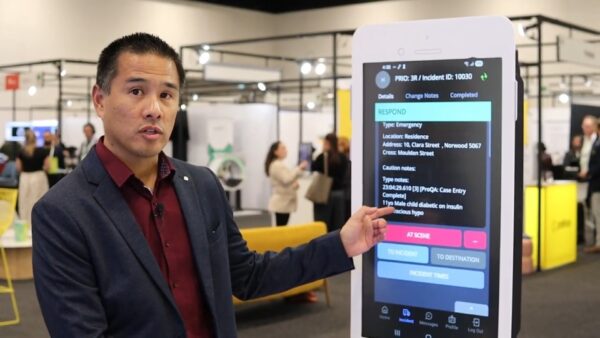
Corvanta’s new Body-Worn Personal Duress solution combines a lightweight wearable duress button with our mobile Incident Response Application, allowing personnel to discreetly trigger an emergency alert with a single button press. The button can be attached to vehicle keys, belts, uniforms, or operational equipment, ensuring it is easily accessible when needed.
Unlike other mobile duress applications that require direct interaction with a phone, the wearable button provides immediate activation without needing to unlock, locate or operate a device during a high-stress incident.
By integrating directly with existing Computer Aided Dispatch (CAD) environments, communications centres can receive, locate and respond to duress incidents within established operational workflows.
The result is a complete end-to-end duress capability that enhances paramedic safety while extending visibility beyond the vehicle.
2. Clinical Companion Application: Modern Clinical Information at the Point of Care
In high-pressure clinical environments, every second spent searching for information creates additional cognitive load for clinicians.
The new Clinical Companion Application reimagines how paramedics access Clinical Practice Guidelines (CPGs) and critical reference information in the field.
Rather than forcing clinicians to navigate multiple documents, calculators, PDFs and reference systems, the Clinical Companion App consolidates everything into a single mobile-first experience.
Drug calculators, clinical flowcharts, dosing information, contraindications and reference material are presented together in one unified view, reducing clicks, screen changes and time spent searching for information.
Agencies can publish urgent clinical updates, policy changes or therapeutic goods recalls directly through the platform. Notifications can be configured to require acknowledgement and can integrate with learning management or governance systems to provide a closed-loop process for communication and compliance tracking.
Most importantly, agencies maintain complete control through a simple self-service administration portal, enabling guideline and content updates without lengthy deployment cycles.
The result is faster access to trusted clinical information and greater consistency across the workforce.
3. Meal Break Management: Automating a Growing Operational Challenge
As demand for emergency services continues to rise, managing crew meal breaks has become increasingly complex.
Dispatchers and duty managers must balance industrial award obligations, operational demand, resource availability and crew wellbeing, often through highly manual processes. In some organisations, dedicated personnel are assigned solely to managing meal break compliance.
Corvanta’s new Meal Break Management Solution has been developed to significantly reduce that burden.
The solution provides a live dashboard that monitors crew shift status and meal break eligibility in real time, automatically tracking requirements against the relevant industrial award framework.
Rather than manually monitoring status changes and applying operational rules, control room teams can focus their attention on responding to incidents and supporting frontline crews.
By automating a traditionally labour-intensive process, ambulance services can create more efficient and sustainable control room operations.
As ambulance services continue to evolve, Corvanta remains focused on delivering practical innovation that strengthens safety, improves clinical decision-making and helps agencies get the most from their existing technology investments.