One of the biggest changes on the horizon for out-of-hospital care isn’t a new drug or medical device, but a new kind of tool: Artificial Intelligence (AI).
Whilst AI isn’t going to replace the clinical judgement of a paramedic, it’s already starting to reshape the administrative and cognitive load that surrounds that judgement – freeing clinicians’ attention for what matters most: the patient.
As ambulance services continue to experience increasing demand, AI presents an opportunity to improve efficiency, support workforce wellbeing, and enhance patient outcomes. Here’s a closer look at how these technologies are beginning to reshape paramedicine.
Clinical Support
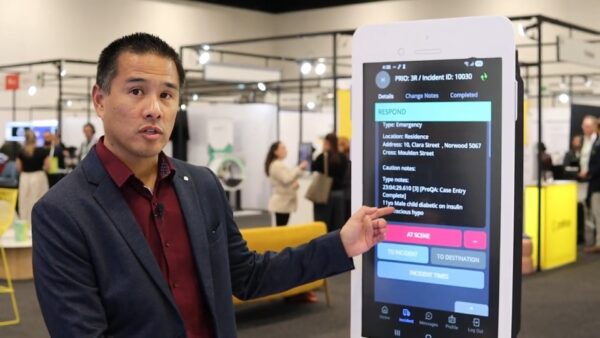
- Voice-to-structured ePCRs: Ambient AI recording technology can capture paramedic assessments and integrate with medical devices to record vital signs, medications, clinical scores, treatment decisions, and responses to care. AI can then convert this data into structured ePCRs in real time, improving data quality, accuracy and continuity of care while reducing administrative burden and freeing up valuable paramedic time.
- Automated handover summaries: AI can generate concise, standardised handover reports directly from the ePCR, quickly providing emergency department staff with accurate, consistent information.
- Clinical Decision Support: AI can identify trends and patterns such as Occlusion Myocardial Infarction (OMI), automatically calculate clinical scores and detect deteriorating vital signs, repeated medication doses, or changes in patient condition. Based on the clinical pattern and operational context, the clinician can be presented with risk scores and prompted about relevant guidelines and procedures providing another layer of clinical safety.
Comms Centre
- Cardiac arrest detection: Listening for the audio signatures of cardiac arrest such as abnormal breathing patterns, specific word choices and vocal stress, AI can prompt call-takers when the model detects signs of cardiac arrest saving precious minutes.
- Language translation: real-time interpretation of languages moves from a human interpreter to real-time, in-call translation.
- Chatbots and non-emergency triage: conversational AI voice assistants can talk naturally with callers, assess their needs, and either connect to a human immediately or forward to the right service in non-life-threatening situations.
Paramedic Safety: Fatigue Monitoring and Wellness Management
- Predictive fatigue management: Rostering, workload, and shift-history data can identify individuals or crews at increased risk of fatigue before safety issues arise.
- Wearable technology: Smart watches, rings, and mobile applications can continuously track heart rate variability, sleep quality, activity levels, and other physiological indicators. Machine Learning can combine these signals to improve fatigue detection accuracy.
- Driver monitoring systems: In-cab eye and facial tracking technologies can detect signs of drowsiness and trigger real-time alerts, helping reduce the risk of fatigue-related driving incidents. Emerging solutions may also analyse voice patterns and response times to identify early warning signs.
A Considered, Pragmatic Approach: What the Industry Must Get Right
To deliver real value for the industry, AI must be implemented safely and reliably, with paramedic trust at its core. This requires:
- Privacy and Security: AI systems must protect sensitive patient information through strong security, clear data governance, and transparent data handling practices. Platforms must meet robust standards of encryption, access control, and data governance and sovereignty, with clear agreements about where data is processed, stored, and by whom (particularly where third-party AI vendors or cloud infrastructure are involved).
- Real-World Performance: Solutions must be tested in the challenging ambulance environment, including noise, movement, and high-pressure clinical situations, with reliable fallback processes when needed. Rigorous, real-world testing must establish a clear understanding of failure modes, i.e. what happens when the system mishears a drug name, a dose, or a time?
- Clinical Accuracy: AI-generated documentation should always be reviewed by clinicians, particularly for critical information such as medications, allergies, and patient deterioration. High-risk fields such as drug doses, allergies, and times of deterioration must be given particular scrutiny.
- Alignment with Clinical Practice: AI tools must be configured to support each agency’s CPGs, protocols, and scopes of practice so that the technology reinforces their own standard of care, rather than reshaping it.
- Clinician Trust and Change Management: Successful adoption depends on involving frontline staff early, providing appropriate training, and positioning AI as a support tool – not a replacement for clinical judgement.
The Bottom Line
AI holds real, practical promise for paramedicine by providing faster, more accurate documentation with a genuine opportunity to improve patient safety and reduce paramedic cognitive load. But out-of-hospital care is an unforgiving environment for technology that hasn’t been properly tested.
The agencies that will get the most value from AI will be the ones that treat it the way they’d treat any new clinical tool. This means ensuring solutions are piloted carefully, governed rigorously, aligned tightly to their own CPGs and operational contexts, while never allowing technology to substitute for paramedic judgement.
At Corvanta, we are considering how the opportunities presented by these technologies can be applied in a safe, considered, and practical way for Australian ambulance services.
If you would like to be part of this conversation, or you have suggestions for how these technologies can practically assist you in your role, please get in touch as we’d love to hear from you.