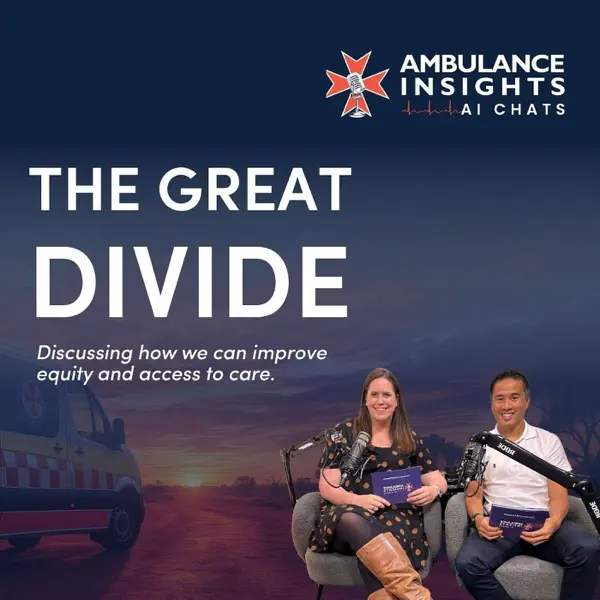

We can’t think of a better guest to conclude the Great Divide Series than Peter Bradley. A leader who’s had a rare vantage point across two vastly different ambulance systems i.e. London Ambulance Service and Hato Hone St John.
From urban congestion to remote access, scale to spread, this conversation explores the real trade‑offs between metro and regional service delivery, and the lessons each system can take from the other.
Brought to you by Corvanta and the CAA.
Han-Wei Lee [00:00:49]
Welcome to the final episode of the Great Divide Series. I’m Hanway Lee.
Lindsay Mackay [00:00:51]
And I’m Lindsay Mackay. And we are joined today by Peter Bradley, the CEO of Hato Hone St. John. So I am going to read a bit of your bio here, might give a little bit of your age away here, Peter.
So Peter’s career in ambulance service spans more than three decades. He began on the front line in New Zealand, went on to lead one of the world’s busiest ambulance services as Chief Executive of the London Ambulance Service, and later returned home to lead Hato Hone St John through some of the most challenging periods in its history.
You today respond to almost 700,000 emergency calls, cover around 90% of the population and nearly the entire geography of New Zealand, and does so through a really mixed funding and workforce model. Across Peter’s career, he has led through major incidents, public scrutiny, and fundamentally different system designs, offering a rare perspective on what really sits behind the so-called Great Divide in the ambulance services.
So Peter, welcome to Ambulance Insights.
Peter Bradley [00:01:49]
Thank you. Nice to be here.
Han-Wei Lee [00:01:50]
Peter, Lindsay’s talked about some of your leadership in ambulance services across the globe. Leadership in ambulance is often shaped less by titles and more by moments. You’ve led your crews and your people through some really extraordinary mass casualty events. The London Olympic Games and later events like the Ari White Island Disaster here in New Zealand. When you look back across your career, is there an event or a moment, that changed the way you think about leadership and why has that moment stayed with you?
Peter Bradely [00:02:25]
I think what’s important is that you have to earn respect and credibility. And going from New Zealand to work in England, there’s an assumption that because you’ve worked in an ambulance service that you’ve got to earn it. Moving across to England was probably the biggest life-changing experience, probably back to England to, in the end run the London Ambulance Service was a big thing for me.
And that shaped my leadership, I guess, because you had to go from running what was a small ambulance, smallest ambulance service in Auckland to running a very, very large ambulance service. That really shaped me through a really difficult first three or four years there, where you really had to, you know, it didn’t matter how well respected you were in your previous role, it was like starting from scratch. So that for me, was my leadership having to really be on top form and really prove myself even though I was a mid-career senior manager. I had to really that that first three or four years back in London.
Han-Wei Lee [00:03:26]
So were you, CEO of St. John, New Zealand?
Peter Bradley [00:03:28]
No, I wasn’t. I was what was called the Chief Ambulance Officer for the Auckland Northern region. Because we had separate ambulance services then. So I was a senior person, and that’s partly why I left because there was nowhere else to go really in New Zealand. So I was in charge there and then went down to university for a while.
Han-Wei Lee [00:03:51]
I guess going froma smallish region like Auckland into one of the busiest ambulance services in the world would’ve been quite the contrast.
Peter Bradley [00:04:05]
It was, and I think it’s a good test, isn’t it? Because it makes you defensive for people who apply for roles who’ve been in small organizations. A bit like even Jordan going from Tasmania to Ambulance Victoria. I mean, leadership’s leadership, so, it can be scaled up. So I really had to prove myself because I was from little old New Zealand.
So I think it’s about, you know, recognizing that you’ve got to be prepared to take a few steps back in terms of humility, but also really make the effort to show that you are capable and suitable for the role. So that’s a good thing.
Lindsay Mackay [00:04:40]
I think it really talks to, you know, that around those transferable skills. As a leader. And I think in paramedicine it’s something that we notice that as paramedics, being three paramedics, we’re not the best at that. Like, where we actually realize that we don’t have to be in the same system where, you know, we can take our skills and transfer them elsewhere.
Peter Bradley [00:05:00]
Yeah, exactly. I think increasingly there’s a recognition that people can, you know, move around. Going back a few decades, there was always a desire to try and have an ambulance person, as it were, in charge of ambulance services in the UK at least. And of course, by and large when I was over there, that was the case but now increasingly they just don’t have the people, you know, that’s the whole story in itself. That’s the succession planning and making those roles attractive for people who are paramedics by background who want to have these roles.
Because these are great jobs. They’re challenging, but they’re also really rewarding. So we want to encourage more senior managers in the ambulance service who’ve got ambulance background to be able to aspire to those roles.
Lindsay Mackay [00:05:38]
And you know, one of the things I find with ambulance services is, especially from, I’ve worked in ambulance and across health is that, ambulance has so much scrutiny. More than I think within health. When think to some of the big events that you’ve managed, in those moments, what do you think about being leading in those spaces in an ambulance service compared to what maybe leaders have learned in the health system? Like do you think there’s a difference? being a leader in that space?
Peter Bradley [00:06:09]
Certainly is. And of course you’ve got a mobile workforce that are out in the field, working shift work from very many different locations and therefore you haven’t got the benefit of being in a healthcare system where say it’s all in hospital, it’s all in one location or two locations.
That does print a lot of challenges in terms of maintaining a connection and I think it’s very different. There is, as you say, quite a lot of scrutiny and, and certainly from a target perspective. Less so in New Zealand, but certainly in the UK, the requirement to hit response time targets and to achieve those targets. And the scrutiny when I was there was absolutely intense and people did lose their job because they weren’t able to achieve targets, which became increasingly impossible to achieve anyway.
So, I think an ambulance service scrutiny is different. The health system has a lot of different parts to it, but the ambulance, you know, we are schizophrenic, right? We’re part of the health system, but we’re an emergency service. And trying to maintain, both those, a foot in both camps, I think is important. You know? And sometimes the pendulum swings too far.
You become part of the health system, but people want to be, you still want to be seen as an emergency ambulance service. So, it’s balancing act.
Lindsay Mackay [00:07:16]
Just out of curiosity, in New Zealand. So I find, when I was in England, you know, I couldn’t have necessarily even told you who my CEOs were. They weren’t in the media very often. When I came to Australia, they were in the media all the time. I know it’s been an executive. I was in the media all the time. Is it like that here in New Zealand?
Peter Bradley [00:07:31]
No, it’s very different. Very different. And my reflection is that the state run ambulance service, the political, the closeness to politics is much different. In the UK and here, you just don’t have that.
Even in the UK it’s not the same, you know the ambulance services are by and large left alone. They aren’t sort of a political, so we don’t have that.
Han-Wei Lee [00:08:00]
Just going back to the scrutiny on ambulance services and the KPIs, um, we recently had a panel discussion, with Jordan Emery, Nick and Jason from London. And increasingly, the move is to move away from that measure of an ambulance success away from those, priority lights and sirens, response times to more patient outcomes.
What does that look like in a New Zealand context? Are you having success with sort of saying to government, it’s not just how fast we get there, but you know, how we manage the right care for the right patient at the right time?
Peter Bradley [00:08:42]
Yeah, I mean, it is an interesting conversation in its own right. I guess the whole thing around response times and what ambulance services should be responding to. And, I’ve always had a view that you can’t stop people calling triple zero or 9, 9, 9, you’ve got to accept they’re gonna call, which what you do with a call when they’re ring.
I think in New Zealand, there’s no real, for good reason, I think there’s no real strong scrutiny on time. but there’s, there’s no getting away from it. You look at all the patient experience surveys, satisfaction surveys. Speed is always number one. What do you want from the ambulance service? Speed. Number two. Speed. What do you want? Number three, there’s an assumption that when you get there, you provide good care. So trust and confidence comes from speed. And that will always be the case. So I think there’s no getting away from that. I do think that, I’ve made some mistakes over my career, because I did a review of the ambulance services in England, the National Review, and we looked at response times and we, we changed it to try and make it, there’s a lot of gaming going on, a lot of, lack of transparency over, you know, perverse incentives to try and deliver performance tags which became quite a toxic situation.
Ambulance managers were under intense scrutiny. It wasn’t unusual for me to check, performance 50, 60, 70 times a day on the phone, seven days a week for 12 years. So I think the move’s been good. I think there’s, there has to be a recognition, there’s a bit of naivety at times about how many calls can be handled through other means other than sending an ambulance.
So there’s a balance to strike. And the system, the health system and what’s available in the system plays a big role in actually how much, how far you can go down the sort of alternative route. But yeah, I mean, by and large, I think response times are always, there, always a need for trust and confidence and speed for some calls, small numbers. But you still have to have an outlying time for some sort of response or care at least.
Han-Wei Lee [00:10:19]
Interesting. I guess following on from that, London (millions of incidents a year) to St. John where you’ve got, I think it was 700,000 emergency calls, one of your busiest years on record. What does the difference in expectations look like, for you say your scrutiny in London Ambulance, scrutiny from government and public in London Ambulance versus here in St. John?
Peter Bradley [00:10:44]
Oh, it’s like night and day. I mean, and it’s like absolute night and day. I think there’s no real comparison. Yeah, the media interest, the political interest, the health. In fact, in the UK was more around the health system expectations, rather than the politicians. I think, you know, there’s a wide, the national health, the NHS has got its own super structure of management, and you’re accountable through that structure, through a management structure really, rather than directly to government.
I think here it’s just very different. I think New Zealand’s culture is different as well. Yeah, the public expects, you know, they want a good health system, but you know, we pay lower taxes and people in rural areas expect to wait longer. So I think the public here are a lot more, discerning or, understanding. Whereas in the UK you tend to get lumped into the NHS is a mess and there’s, you know, it’s not working.
So I think it’s very hard for ambulance services then to become a separate entity in terms of their own, uh, how they’re viewed at times. It’s just the difference is, you know, profound. By and large we get left alone and I think the problem had been, you know, I’ve always had this view that you can have, I don’t mind the idea of high accountability with proper funding. What you don’t want is high accountability with no funding. And I think in New Zealand what I had, what I experienced when I joined was no accountability and no funding. So it’s sort of, so the one you get the worst, you get left alone. I’d rather have my accountability. I’m absolutely all for accountability.
You’ve got to be accountable, you know, it’s public money, right? And public donor in New Zealand, so you are even more accountable. But with that comes an expectation that you’ll get the funding you need to deliver a safe service.
Lindsay Mackay [00:12:20]
I mean we’ve only been in New Zealand for, uh, 24 hours. And we met some of your teams yesterday and I think it goes to that, that Kiwi attitude, what you talked about. Because we definitely experienced that, the welcome and the sharing of information and talking about the service. Your teams are so positive. Like the culture was lovely to witness and people were so friendly. Definitely. So, yeah, I just had to call that out. Like, it was nice.
And I think St. John’s obviously is big in the community and it has a brand in itself. And you obviously you have a large volunteer workforce sale in New Zealand. If you think about it, with the London model, then coming to New Zealand as the CEO and then how do you balance making decisions, because I can imagine it’s different when you’ve got the public money in the UK and then here you’ve got to balance the public money, the community, the responders. How do you do that in a kind of forward planning risk way?
Peter Bradley [00:13:26]
Yeah, it’s quite a complex organization. You know and it is a strength, but it’s also a challenge at times, or it has been in the past.
So we’re an, we’re an emergency ambulance service, which is, um. Main activity in terms of funding and turnover and people, but we’ve also got this, community charitable service with thousands of volunteers providing community programs. So I think managing that as an entity in totality has been over the years quite challenging.
So I think from an ambulance service only perspective, we’ve got like, 2000 plus frontline staff paid, and then we’ve got, you know, a couple of thousand volunteers. So, it’s about making sure the model’s right, and you’ve got the right workforce mix and skills for the different areas that you operate in.
And that’s been a bit of a challenge as well in terms of trying to make sure you’ve got the right people in the right place at the right time. And, particularly in rural areas where you’ve got a large volunteer workforce. So we rely on our volunteers. And it’s a good model.
We’ve got incredible volunteers putting a huge amount of time and effort, and our expectation of them has increased over the years in terms of their training. So we try and do a lot more and get government support to support those volunteers as well. Because, you know, it’s a public good and that volunteer contribution’s worth over a hundred million dollars a year. We’ve had some independent research done to say, what’s the business case to justify investing in volunteers, which the workforce is provides for a couple of million dollars, a hundred million dollars worth of value. So it’s really important.
Han-Wei Lee [00:14:50]
Peter, throughout this series, we’ve talked about the great divide. Often, people assume that’s urban versus rural, or density versus distance. From your perspective, having gone from one of the most urbanized ambulance services in the world to quite a dispersed urban/rural mix. What’s the most challenging aspect of the great divide? Is it funding? Is it system design? Is it expectation or is it the geography itself?
Peter Bradley [00:15:20]
I think it’s probably a bit of all those inevitably, isn’t it? I think in an urban service, like London for example. You’ve got a small geography, high density of traffic in people. And I think that the benefit is you’ve got everything contained within a thousand square kilometers and therefore you’ve got more access to pathways, more access to different opportunities for patients to be, to be given the right care, at the right place.
More hospitals. So the system design, even though it’s got some shortcomings over there, is much more contained and manageable. And even just moving workforce around, it’s just so much simpler in that sense. It’s not withstanding the challenges of the workload, but also the 180 ethnic minorities in England, uh, London. I mean, that brings its own challenge in terms of trying to make sure you’re providing the right service to the right people. And that you’re culturally aware and culturally sensitive. So that has increasingly become an issue to work through. And there’s been a lot of work done over the years in the area.
I think here, in a rural, urban, remote setting where you’ve got bonus season paid staff – the challenge there is really distance, but also often the people in some of the rural calls are some of the most challenging calls. And therefore, you’ve got distance to deal with and getting resources there quickly, but also making sure you’ve got the the right support for the people who are often lower trained level of people in our rural areas. So getting that response model right, is more difficult in a rural setting.
Han-Wei Lee [00:16:51]
In that rural setting, is there a place for technology in those sort of different systems? So digital tools and data was probably abundant really in LAS versus the connectivity gaps you might have here in New Zealand. What does that look like?
Peter Bradley [00:17:07]
I think there’s a lot of work being done from a technology, sort of national infrastructure resilience perspective in terms of the government’s invested one and a half billion dollars in a new Communications network for police, fire, and ambulance in New Zealand. It’s called the Next Generation Critical Communication System. That’s big because often the ambulance services don’t get, well, ambulances have got poorer communications than police.
So this is big. This is a sort of 10 year program, so that’s going tomake a big difference, and it is making a big difference for connectivity. So I think that will really be a game changer for our rural people. It will improve connectivity, ability to connect and communicate, but also will mean we can use more tools. You know, we can use telehealth more, you know, video. So I think that’s an area to work on, but recognizing that our volunteers are well equipped to deal with the technology we give them is going to be really important. But fantastic opportunities. And it is an absolute requirement to do that. You know, we can’t leave ourselves behind in that area,
Lindsay Mackay [00:18:19]
And I think it goes to what you were talking about earlier with performance times. I read that, under your leadership ultimately you’ve always met your performance times, which is amazing. I don’t think there’s many leaders that can say that.
Peter Bradley [00:18:27]
Well, it depends on the targets, right? No. I mean, we’ve put it down to the team, you know, we’ve got a really good leadership, ambulance leadership team and people who have really done a lot of work over the years. We’ve got really good management information and business intelligence stuff to really make sure we’re, focusing on putting the right people in the right place. It’s a big team effort, right.
Lindsay Mackay [00:18:55]
And I think the other thing that struck me was not just to be meeting performance targets, that we all have agreed it’s not always been the best metrics, but you also have been a leader as one of the most trusted charities, I read as well. Which is, that’s outstanding that you’ve been able to balance both of those.
Peter Bradley [00:19:12]
And hence why people want to donate. I mean, you know, it’s a very special model, I think in New Zealand where, and obviously I’m English by birth and returning back to New Zealand, it was a good reminder for me that not only have we got an amazing volunteering sort of ethos in the country and in Hato Hone St John, but also, people’s generosity to give is just absolutely astounding. You know, millions and millions a year get given to St. John to help run the ambulance service.
Lindsay Mackay [00:19:38]
And it seems like the public trust is very high.
Han-Wei Lee [00:19:45]
I think,we all remarked, I knew there was some level of community donations for vehicles, but what really struck us yesterday when we were talking to your people was that every single vehicle is essentially publicly donated, which is mind boggling coming from Australia.
Peter Bradley [00:20:05}
And I think it’s an ongoing debate around getting the model right in terms of the charity, you know, because, it’s a old composition itself around are you government run or are you an NGO and you know, there’s arguments for both, right? I’m agnostic about the right model for who runs an ambulance service, because I’ve worked in a government run and a charity-run.
I think that, as long as you’ve got the right funding and the right infrastructure and the right people and the right leadership, then it doesn’t really matter. But either way, it’s getting the right model. And I think we’ve been in a position where we’ve relied too much on fundraising to run an emergency ambulance service.
So now’s the time to finally get that right once and for all and say, listen, we can get ambulances donated, but the government needs to pitch up here and pay its fair share.
Lindsay Mackay [00:20:44]
And we can see obviously with the changing demographic of the communities that’s happening and what’s coming our way and we think we’ve talked about in some of the other podcasts – it’s about then keeping that pace as well with the forward thinking. I can imagine is something quite complex in this situation as well.
Peter Bradley [00:21:05]
Yeah, it is complex and, you know, we want to innovate and keep doing the right thing, but as we said, you’ve got to do the basics well too. And I think the big focus of the team, the operational leadership team really has been to, get the basics. Do the basics well. It’s all very well to focus on the nice, shiny things, but you’ve got to make sure, have you got ambulances? Have you got uniforms? Have you got people, have you got build good buildings?
Because that’s what ambulance staff want, right? Am I getting a break? It’s the most important thing. Am I finishing on time? Do I know when I’m working next? Am I getting paid? All right. You know, I’ve got the equipment I need. So it’s like the old Maslow thing isn’t it. Doing the basics well, that’s been a big focus.
Han-Wei Lee [00:21:37]
Like we said, you began your career in New Zealand. You built senior leadership experience both here and, in the UK, and then you’ve returned home. How’s that full circle journey shaped how you think about leadership and stewardship?
Peter Bradley [00:21:52]
Yeah, it’s an interesting question, right? I mean, I’ve been fortunate to have had a really good, I’m getting towards the end of my career, obviously, not too long before I finish here, I guess. But I’ve been fortunate to play leadership roles, in England and in New Zealand, which is reasonably, reasonably unique, And to run two ambulance services, I’ve always stuck to some fundamental principles. I only got into management in the ambulance service because I was a paramedic and I saw things that weren’t happening that should have been happening.
And I thought, well, there’s no point in whinging about it, Pete, again, do something yourself. So pull yourself into a position where you can make some changes. And that’s how it all started for me. So I’ve always had the basics. You do the basics well, in management, for me, it’s always been about being accountable, transparent and responsive.
You know, it’s just basic stuff, you know? Answering emails. Not holding things up, getting back to people. But I’ve also learned that you don’t do it at the expense of other people. It’s very easy in these senior leadership roles.
WhenI went to London, I went out on the ambulance stations and took some post-it notes and wrote down the things that they were telling me what need you doing? This needs sorting. And then you go back and sort it all out. Oh, that Bradley’s a good bloke, isn’t he? Wow. He gets everything sorted out. But you don’t want to be doing that because you want to empower the managers underneath you, you know, you don’t need the credit. And I’m at a stage where I don’t need the credit in my career.
The other insight for me has been that in senior leadership, people want thanks from their manager, line manager, not from Peter Bradley or from the chief executive. They want it from the people. That’s the most important thing because that’s their connection point. That’s the person they deal with the most. So I’ve learned that, a lot of my role is thanking people. By the way, I’m the chief thank you officer. I see that as my job. You know? Because it’s an important part of what you do, right? Showing gratitude. So, I’ve always held onto some principles, which have always seen me through, and that’s, there’s no magic to get into senior roles. You’ve got to have some competency, right? And some brains. But it is about just doing the basics and people thinking, wow, he does what he says and he gets stuff done. There’s no magic to it. It’s not mysterious.
Han-Wei Lee [00:23:57]
I think, you know, all the values you’ve espoused could be core values in many organizations. And I think you’ve just sort of highlighted the importance of all those basic tenets of leadership in terms of keeping your people happy. Thank them. Clothe them. Water them. Feed them. It’s really important.
Lindsay Mackay [00:24:20]
And I think, it’s not obvious that you’re coming to the end of your career, you said obvious, but, uh,
Peter Bradley [00:24:21]
I’m very mindful of that. You, I’ve said to someone the other week, because I’m bit too open with the feedback, but sometimes when you, when you start your career, I got promoted quite young and got quite a senior role, quite young. And I always had this thing around being too young and whether I have credibility in front of all these other older men.
And then, I was in the ambulance service, which wasn’t quite the same as a police and fire back in the day and think, you had to work extra hard to, to feel, it was a bit of an imposter syndrome thing. And then you get towards the end of your career, you think, they must think I’m too old now. So you still have to prove yourself, can’t win. So, the important thing is that there could never become complacency. You know, I’m as hungry now or as keen now as I was from, you know, I’ve been 27 years as a chief executive. So for me, I’ve got to make sure I can satisfy myself that every day – am I adding value? Am I making a difference? I can’t just coast, I’ve gotta be doing something which is adding value, and that people think it’s adding value. Having no complacency is absolutely crucial. Because once that creeps in it’s time to go. So that’s been really important to me. Keep learning and keep making sure that you’re on top of your game.
Linday Mackay [00:25:32]
I think so much what you’re saying definitely is resonating with me. I was very young when I got quite senior. I mean, I’m heading into my third decade in ambulance, and sometimes I think what’s next? I feel like I could talk to you for ages about that, but, it is really exposing career. It’s tiring. You talked earlier about, I know exactly what you were talking about. I used to have two phones in my pocket. I used to have to bring one out. I’d be checking that screen. My husband used to ask, what was I doing? I can hear you but what kept you here in ambulance?
Peter Bradley [00:26:04]
I didn’t intend to, before I went to England, I didn’t intend to stay in the ambulance service. I was mid thirties and I went and did an MBA down at the university. I went full time, which was a big thing because I actually left, I actually resigned from my job, with my family and moved to the end of New Zealand, with no prospect of looking for a job. Looking back, that’s probably the biggest thing I did, sorry, the most courageous. I had this sense that I wasn’t qualified. You spend your time as a clinician doing more and more training and keeping yourself proficient and learning more skills and going through continuous education. Then you become a manager, and now, oh, well you’re a manager now. I’ve always had a view that as you advance your skills as a clinician, there’s a requirement to advance your skills as a manager.
So I felt ill-equipped. I wasn’t, but I felt ill-equipped. Without having any management qualification. So that was the only reason I did it. Just for, for my self worth and in a sense that I didn’t know what I didn’t know. So that’s what kept me in ambulance, went there, did it, I did the degree finished and I thought I’d return back to Auckland and, and do something else in health.
But then I got approached completely out of the blue about going to England for a job, which I never expected to get. I never expected to get the job I had to get to, to be offered a job. So, yeah, that’s why I stayed in ambulance.
Han-Wei Lee [00:27:25]
Peter, we’ve talked about the focus on KPIs, but as we know that demand’s increasing on ambulance services, we’ve got aging populations, we’ve got workforce pressures. And constrained funding as well, which we’ve definitely seen post-COVID. What worries you most about the next decade. And what gives you confidence?
Peter Bradley [00:27:55]
You touched on the workforce is a big issue, right? Because people are increasingly mobile with their careers. I think it’s probably a bit of a red herring. You think everyone’s going to leave and become an extended care paramedic and, working in the parts of the health system, it’s small numbers, right? But at the same time, I think as you know, the registration, increased clinical pathways, a desire to get more people working in the wider health system and primary care.
I think there’s an issue around workforce, support, workforce management and workforce planning, planning longer term, right. For the workforce and what the workforce should look like in the future. I think we’ve been pretty good at that overall. But how do you retain a workforce who join at 20 and then by time of 27, want a change?
So that concerns me, what’s the answer there? Because you’re in a constant, people leave, recruit, people, leave, recruit. It’s a sort of constant cycle. So you’ve got to manage that and keep people. People join this job for a purpose. And they enjoy what they do. So it’s about making sure that you look after your workforce the best you can. But that will remain a challenge no matter how good an employer you are. People still want to move on but then often return.
So how’s that managed and how do we connect that with a wider workforce planning of the health system, I guess, is the challenge.
Technology is exciting because there’s so much opportunity there for technology. So much more in the Comm Center. I’ve always thought the Comm Center was the most important part. That’s where the investment, the clinical leadership needs to be in there. The investment needs to be in there. Because the decisions that are made in there and the leadership and the clinical, have massive downstream impacts. So I think we need, we really need to see a lot more investment in comm centers around technology.
But also around clinical support and leadership in those centers as increasingly. Because we carry the risk, right? We talk about, you know, 50% of calls don’t get an ambulance. Well, great, but who’s, bearing the risk for that? . We are, we’re bearing the risk. And as the pressure comes on to do more and more of that, then the risk increases. So managing that risk, managing the clinical governance aspects of that is really important going forward.
I sometimes joke that actually if you’re doing a really good job, then a hundred percent of the people you attend go to hospital because every one of those need to go to hospital, right? So you get to a position where there’s nowhere else to go with that. And I think in New Zealand there are limited, compared to England, there are far fewer pathways for patients.
We’re a small population, 5 million people so that’s a challenge. Maximizing pathways, maximizing the use of data for integration purposes, to get the patient flow. We are small enough in New Zealand and innovative enough to be able to really put a good package together for an EV innovation around data management technology.
Lindsay Mackay [00:30:43]
I think you’re really speaking to the heart of Han-Wei and I coming from Comms Center backgrounds. I always talk about it being kind of the heart of the ambulance service. People don’t always realize that, but if we get it right and we invest well, it has that ripple effect to help every sector of the ambulance service. Leaders sitting across ambulance, they’re so focused on the fleet and the movement of those paramedics, which is white trucks. Which is so important. But if we can get that background in the engine room of the ambulance service working well.
Peter Bradley [00:31:18]
And it needs to be seen as a profession in its own right. It needs to be something that people aspire to. Not, I’m getting towards the end of my career I’ll go back to the comms centre, but actually it’s a career choice. And it’s actually a great career. Exciting. Prospects are good and using technology to the best effect is a big, fantastic opportunity. So I think we really need to put our money where our mouth is there, so to speak.
Han-Wei Lee [00:31:37]
I think we have seen that change in focus. With the increased spending on secondary triage. Certainly in New Zealand. Very much in Victoria. We always, when I started in there, there was a single paramedic taking all the secondary triage calls for MAS as it was then. And now there’s 300 plus, taking what? 30%? Of the triple zero call volume.
Peter Bradley [00:32:05]
That’s fantastic. So there is, there’s a big change coming.
Lindsay Mackay [00:32:07]
I think it goes right back to your comment there about seeing as a professional pathway. Yeah. I think that was a big thing I noticed when I started working in those environments. People used to describe themselves to me as if it was a dumping ground. They said, oh, I just came here because I was dumped here. I’ve got a sore back. Go to the comm center.
So it was one of the big things I can say that was really, that was successful at Ambulance Victoria was the fact that actually people saw it as a career choice and they chose, and if you actually didn’t want to be there, we’ll help you find something that you do want to do. But it’s not a dumping ground. Because it’s such a highly skilled role.
Peter Bradley [00:32:38]
And I think, getting the prioritization system, it’s all we want them for, all the primary triage. That’s long overdue. Long, long overdue. I mean, there hasn’t been enough appetite to really do something about that, you know?
Lindsay Mackay [00:32:55]
It does have to happen. Yeah. And there’s a big push around that at Victoria as well. You’ve mentioned quite a few things, but if you had to challenge the global ambulance sector, to rethink one assumption it holds about ambulance services to progress it to that next generation, what would you? Do you think there’s one thing holding us back?
Peter Bradley [00:33:23]
Not necessarily. I do think, there’s a bit about what we’ve talked about. There’s definitely a bit about the primary triage piece. And the opportunity there to really do something different around how calls, the call takers are, the call taker profession, not a profession, not necessarily in some people’s eyes. How do we really get that primary triage? We’re giving secondary triage, but what about the primary triage? And so, that’s where the big focus, that’s where the calls come in. So there’s got to be a really big, give some really serious thought to, how do we deal with that?
You know, there’s a big school of thought in parts of New Zealand and with some of the funders of the ambulance service that, you shouldn’t even be receiving those calls? You shouldn’t be responding to those calls. You know, you only respond to the high acuity. Well, what about the other four, 500,000? What do you expect us to do with them?
So that’s a big focus. And I think the integrated workforce in rural areas needs a lot more work. There’s not enough justification to have a primary care, you know, ECP type person in a rural area in New Zealand, there’s just not enough work for them. But the mixed model of working on an ambulance, responding to a call, but also working in GP surgery or look at urgent center – doing both. We’ve got some great examples of that.
And there needs to do more of that because we’re just too small and then, the workforce is too small to have this siloed workforce. So there needs to be a bit more openness about that. Because that’s a constraint at times. You know, I’m not employing them. They’re employing them. You know, they’ll work for me. You know, we are too small to be able to have that divide.
Lindsay Mackay [00:35:00]
Yeah. You need to be more fluid, don’t you? Yeah. And I think that would give such good, professional development.
Peter Bradley [00:35:02]
Oh, you know, people want a break. You know, spend 10 years on an ambulance and say, actually if I can work in a GP suite part time, then I might return for a while. You know, it’s like having people who are single response cars for year after year after year. At the end it gets, you know, they need a break.
Lindsay Mackay [00:35:20]
And it goes back to a little bit of the conversation earlier when you talked about, you know, we talked about the performance targets. The thing that has always sat with me since I was young was that, I remember somebody, a manager coming to the station to thank me once because I’d met all my response targets and I remember asking them and saying, that’s great, but that patient actually died. And I said, but I saved the next one that you just told me didn’t meet my target. And it’s always resonated with me. Like I was just young and thinking, why are you congratulating me on a time when a patient died? And I think when we get the primary triage right, we focus on actually right care, right time. I think that’s where we’ll get real value as a service.
Peter Bradley [00:36:00]
I agree. I think the other reflection I’ve got, and I mentioned to the team a few months ago that, the pendulum has swung, we’ve gone from being seen as lights and siren and, you know, by the public, car accidents and all the major traumas to more of the primary care and the secondary triage, which is all well and good, but we still do the STEMIs, the stroke, the major trauma, and so I’ve just been saying to the team, we need to make sure that we don’t let the pendulum swing too far the other way now. So, you know we brought in a national STEMI pathway, national trauma. So how do we make sure that there’s a focus on that still, because that’s where the patient outcome evidence can be more profound, right.
Even with small numbers. So I think we’ve got to make sure we get that balance right. And make sure we remind our politicians and our purchasers that we’ve still got a very important role to play in STEMI, stroke, major trauma, spinal cord, in those areas as well. And I think also for, in New Zealand at least, what’s the next step for us, in terms of those areas to try and make more of a difference, I think.
Lindsay Mackay [00:36:57]
If you had to give young Pete, when he’s starting his journey to where you are today, is there something you wish you’d told yourself or thought about back then? Some advice you’d give yourself, I should say?
Peter Bradley [00:37:09]
Well, it’s the usual thing, isn’t it? I’m a bit of a people pleaser. It’s the old thing – you can’t please all people all the time, and you have to be prepared to make tough calls and well-informed tough calls. And so for me, just being prepared to accept that you can’t keep everyone happy. But do the right thing, at the right time,for the right reason. And take your team with you.
Lindsay Mackay [00:37:32]
I think it’s so important in ambulance and actually to be said, because I think one of the challenges, you know, I’ve obviously moved countries. I’ve worked in different states around Australia. But a lot of the services I go to, with the leaders that I meet, they have started when they’re young and they’re working their way up that ladder as they see it, and then they’re suddenly now having to tell their friends what to do. And that’s a really hard balance. So I think it goes back to your core, which you talked about, your values of actually just being a nice person, actually
Peter Bradley [00:38:00]
Being a nice person helps. Yeah. And being personable and being down the earth. Right. People, you’ve got a better connection with them. And I think that’s a really important point actually. I think what I see, one of the most important skills an ambulance leader can have is. It sounds obvious, but, but changing your tone, changing your language, changing how you approach conversations with different groups of people. There’s a skill to that. And there’s no point talking about management speak to, to frontline staff. Not because they’re thick, but because it’s not interesting to them. There’s no interest. You’ve got to say, what is it, how am I going to change my communication style to work for them?
And also a final point would be that, just about the honesty thing and people connect with that. So when I became Chief Executive London Ambulance Service, it was quite a difficult place to work. And we were really struggling and we’d never been honest with the media about that.
And I went on TV and they asked me a question, I said, we’re struggling, that we are struggling. Uh, and that really resonated with our people, frontline staff. At last someone’s prepared to be honest. You know, not blaming anyone else, just saying we’re struggling. And being vulnerable and showing that was really important.
Han-Wei Lee [00:39:11]
I think that’s pretty powerful. Look, as we close, this is the final episode of the Great Divide Series. What really stands out to me is that, we’ve been exploring, that divide and that it’s not really about distance, density, geography or distance. It’s really about people leadership and the systems we choose to build. And Peter I think your really fundamental core values of leadership, being a decent human being has really resonated with certainly the way I lead and I know the way Lindsay leads as well.
And we’ve heard that similar theme from leaders right across the series. That you’re all facing very similar pressures. And it’s those remarkably human decision in moments that matter. And you can’t always please everybody, as you’ve just said.
I think, yeah, if there’s one takeaway, it’s learning across the systems isn’t just possible, it’s really essential. So I really just want to thank everyone who has joined us throughout this series and a really special thank you to Peter for sharing decades of experience across the globe.
We hope these conversations have sparked reflection for everybody, challenged assumptions, and really encourage you to keep asking better questions about the future of ambulance services. And thanks again for joining us, Peter.
Peter Bradley [00:40:37]
Thanks for the invite. I really appreciate it.